Flip 7 and the Moment You Say “One More”
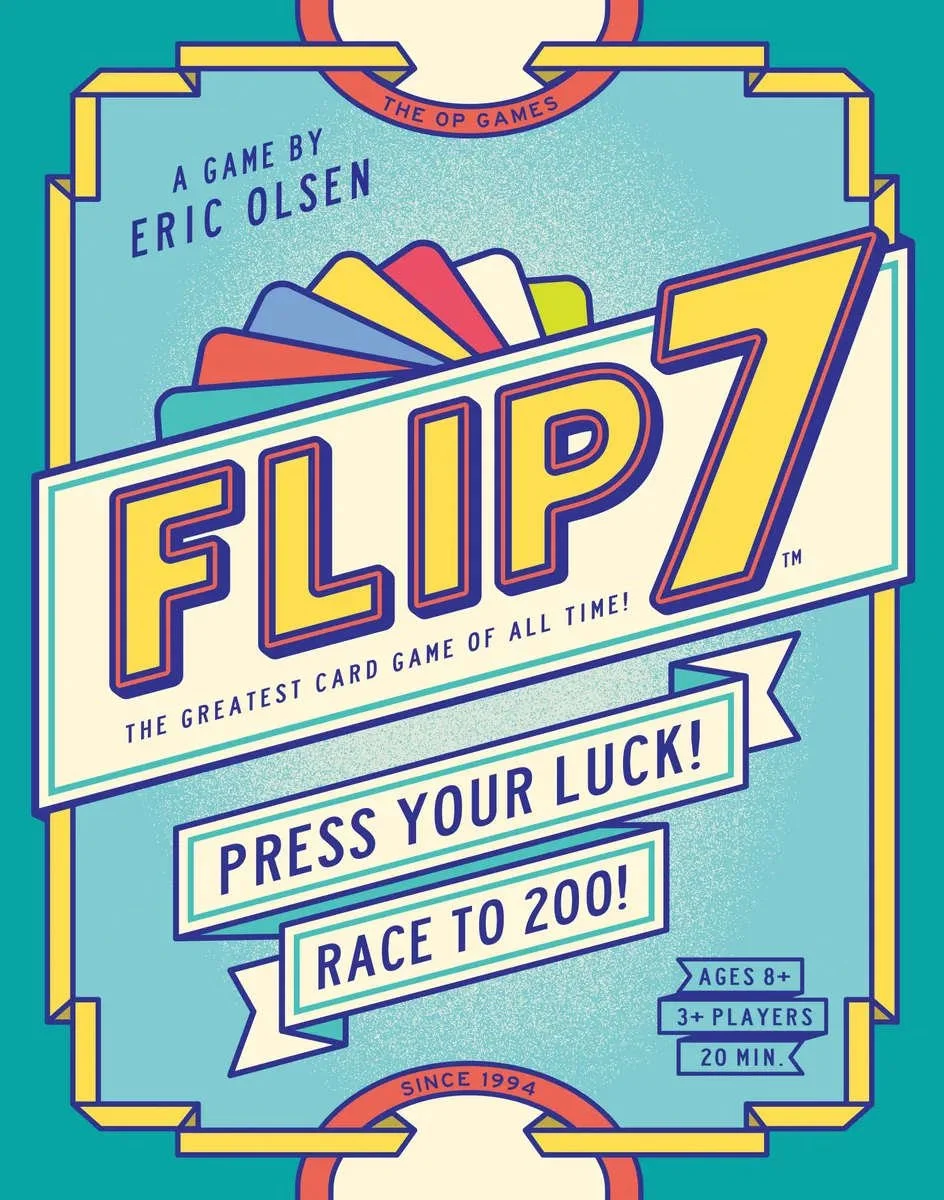
Flip 7 Box Cover
You’re sitting at the table with six cards in front of you. Everyone else has gone quiet. All eyes are on you.
If you flip one more card, you might win the round. Or you might lose everything you’ve built so far.
So how do you decide?
That moment—that pause before the flip—is what I want to write about today, using the card game Flip 7 as the lens. It’s a tiny game, but it creates big feelings.
Flip 7 is a push-your-luck card game published by The OP, designed by Eric Olson, and released in 2024. It’s small, quick to teach, and incredibly good at generating tension. The deck itself does a lot of the work. There’s one 1, two 2s, three 3s, and so on, all the way up to twelve 12s. Just knowing that structure tells you almost everything you need to know about the risk you’re taking.
What makes Flip 7 feel so approachable is that it already feels familiar. If you’ve ever played Blackjack, you basically already know how this works. On your turn, you decide whether to hit or stay. If you take another card and it matches a number you already have, you bust and score zero points for the round. If you stay, you score the total of the cards in front of you. First player to 200 points wins.
And then there’s the thing you’re really chasing: the Flip 7. If you manage to flip seven different number cards without hitting a duplicate, the round ends immediately and you get a bonus 15 points. It’s exciting, a little reckless, and it always feels heroic when someone pulls it off.
When you actually sit down to play, the experience is simple but surprisingly tense. At the start of the round, everyone gets one card, and you’re usually hoping for something low. There’s even a zero in the deck. It’s worth zero points, but it’s one of the safest cards you can have because there’s only one of them. It’s funny how the cards that keep you alive the longest don’t necessarily help you score much.
Then it comes back to you, and you have to decide. Do you stop now and take the points? Or do you flip one more card and risk losing everything? Most of the time, this decision doesn’t take very long. You glance at your cards, maybe look around the table, and go with your gut. Sometimes you see a 12 in front of you and think, “Well, a lot of the 12s are already out. What are the odds?” And then, of course, you flip another 12 and bust immediately. That’s Flip 7 in a nutshell.
The action cards are where the game really starts to sing. The Freeze card lets you stop someone cold for the rest of the round, which almost always gets aimed at whoever’s in the lead. Flip 3 is pure chaos. It forces someone to flip three cards in a row, and depending on who it’s played on, it can either launch them toward a huge round or knock them out instantly. Second Chance might be the best card in the deck. When you have it, fear disappears for a while. You can take risks you’d never normally take, knowing you have a safety net if you hit a duplicate.
There are also score modifier cards that add points or even double your score. They’re tempting, especially the ×2, because they make you want to keep flipping. If your score is going to be doubled, why wouldn’t you try to push it just a little further? Of course, that temptation is exactly what gets people into trouble.
This is where Flip 7 quietly becomes a game about motivation. When you decide to flip one more card, what’s driving that choice? Is it greed? Are you chasing a big score or the win? Is it confidence, that feeling that there’s no way you’re going to bust this time? Or is it simple curiosity, just wanting to see what’s next?
You could try to play logically. You could count cards or track probabilities by watching what’s already on the table. And sometimes that helps. But more often than not, decisions in Flip 7 are emotional. People bust on low numbers all the time, and people get a “bad feeling” and stop even when the odds look fine. Both approaches show up constantly, sometimes in the same player from one turn to the next.
Your position in the game changes things too. When you’re behind, it often feels like you have to take bigger risks just to catch up. When you’re ahead, the pressure shifts. Now you’re trying to protect your lead, and greed becomes much more dangerous. One of the most interesting places to be is second or third place, where you’re close enough to win but not such an obvious target for Freeze cards.
Here’s a mindful prompt to sit with. Think about the last time you flipped one more card in Flip 7. Were you chasing the win, or were you trying to avoid the regret of stopping too soon?
Flip 7 is also a deeply social game. Table talk matters. Friends will encourage you to take risks, tell you that you’re “so close,” and cheer you on right up until the moment you bust. Sometimes the table is loud and persuasive. Other times, the silence is what pushes you to flip. It’s worth noticing how often the group influences your decision. Are you playing your game, or are you letting the table play you?
If you enjoy Flip 7, there’s a long history of push-your-luck games worth exploring. Games like Pairs or Zombie Dice tap into that same tension of knowing when to stop and when to go for it. That question—do I push my luck or not—has been showing up in games for a very long time because it mirrors real life in such a clean, honest way.
There’s an old saying that the only sure thing about luck is that it will change. Flip 7 is a great place to practice noticing when to accept a good outcome instead of chasing a perfect one. Sometimes stopping isn’t quitting. It’s choosing.
If you want to play Flip 7 a little better, the biggest “strategy” is learning to adjust your risk as the game goes on. Take a little more risk when you’re behind. Lock in points more often when you’re ahead. Pay attention to what cards are already on the table, but don’t overthink it. And when the moment feels right—especially if you have a Second Chance—that’s when you go for the Flip 7.
So here’s one last prompt. The next time you play Flip 7, don’t just notice what decision you make. Notice how you make it. Pay attention to the flip.
If you enjoyed this reflection on Flip 7, you can sign up for the mailing list and receive mindful game prompts straight to your inbox. And if you know someone who loves card games, share this with them.
Just don’t blame me when they say, “One more card.”