Mistwind Review: A Unique Pickup and Deliver Board Game Explained
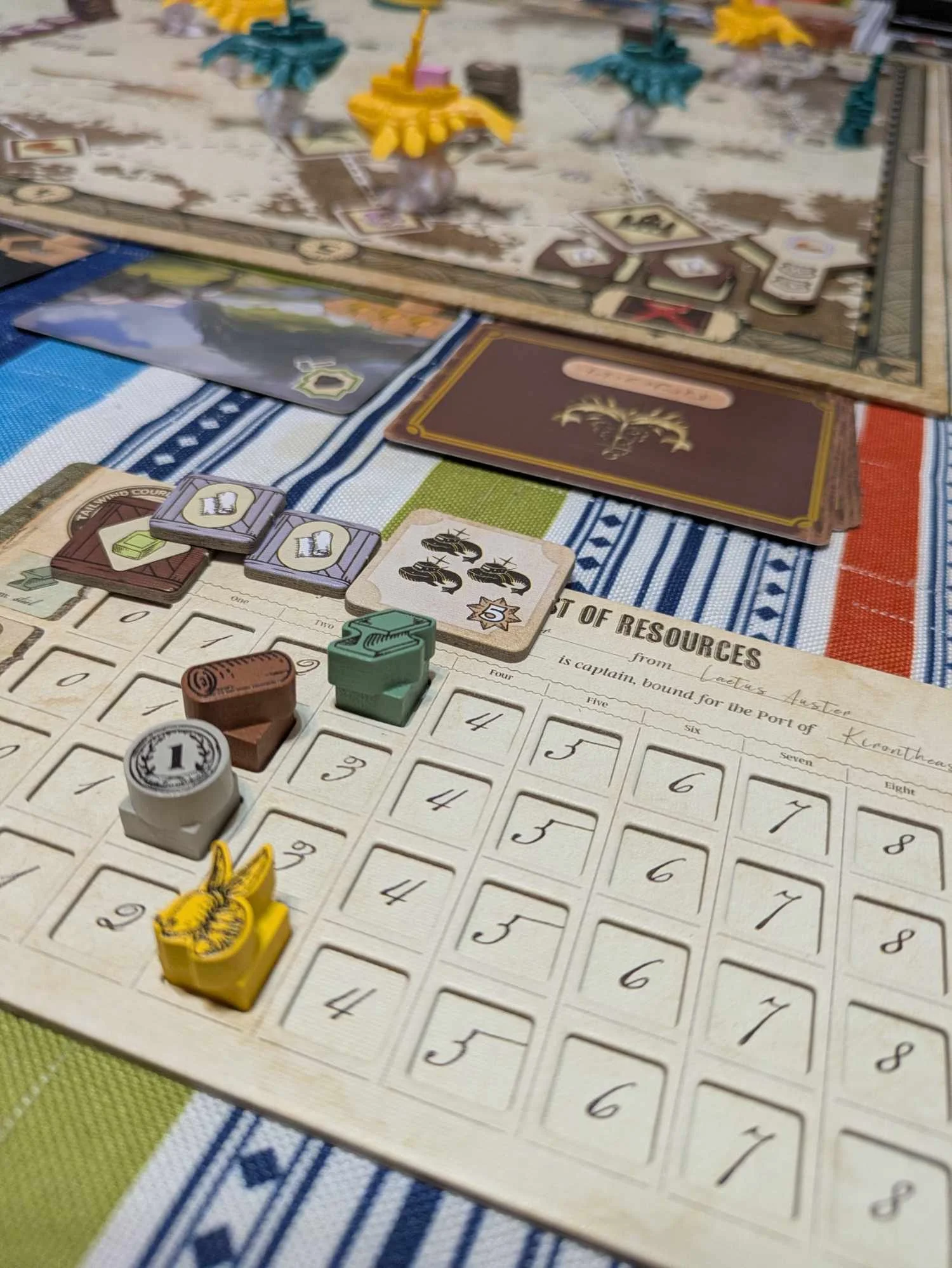
Mistwind Player Board
What if your delivery route wasn’t roads, but ever-shifting winds of mist in the sky? Today we’re talking about Mistwind, published by First Fish Games—and this is not your typical pickup-and-deliver game. It’s much more than that.
The setting here is a world of floating islands and magical winds, with transport whales soaring above the thick mist. That alone is what pulled me in. The idea of whales carrying cargo through the sky is just…cool. Both my wife and I love whales—we’ve actually traveled to Maui and Alaska mainly just to see them—so we were immediately drawn to this game.
I picked up Mistwind at Gen Con 2025, and out of everything I bought there, it’s the one that’s hit the table the most. That alone says something.
In the game, you take on the role of the head of a trading company, transporting cargo from port to port, gaining resources, building outposts, and managing your transport whales. You can build up to twelve outposts and have up to three whales at a time. The aesthetic is fantastic. The resource cubes actually sit on the whale miniatures to show what they’re carrying, which is a small detail but adds a lot. The artwork is equally impressive. The character cards give you a sense of the citizens in this world, and one of my favorites shows a person carrying a piece of krill that looks almost too large to hold—it gives you a real sense of scale. The port cards are filled with images of whales gliding through the mist, and it creates a sense of wonder that really elevates the experience.
At its heart, the game is about picking up goods and delivering them, but there’s a lot layered on top of that. You’re creating a network of outposts, connecting regions, and scoring points through network cards and tokens. There’s also a race for achievements that changes every game. You might be trying to build all three whales or spread your outposts across all four regions. There’s always something to keep in mind, which gives the game a surprising amount of depth.
What it’s like to play
What really defines the experience, though, is how your turns play out. At the start of each round, you have five action discs numbered one through five, and you have to discard one before anything else happens. That simple decision forces you to plan ahead. You look at the board, think about what you want to do, and try to map out your turn. Maybe you want to save your five to grab resources, your three to pick up a character, and your four to build in a specific region. But things don’t always go to plan. There have been plenty of moments where I’ve thought, “I really shouldn’t have discarded that one.” And that’s part of the learning.
When it’s your turn, you place one of your remaining discs on the board and take that action. You might gather resources, buy a character, use the labor board for various effects, or play on a port card to build outposts and whales. Some spaces are limited, so timing matters. The port cards are especially interesting because players can stack their discs, and whoever is on top at the end gets the bonus. That creates this subtle tension of when to commit.
Then comes movement, which is where the game really shines. Moving a whale usually costs krill, which acts as fuel, but if you move from a space with one of your outposts or another whale, it’s free. That means you can create chains across the board and move in really satisfying ways if you’ve planned well. You move all your whales first, and then you load and unload cargo, which adds another layer of sequencing to think about.
There’s also a reward phase where you claim achievements, followed by resolving those port bonuses. It all flows together into a system that feels simple at first but reveals a lot of depth the more you play.
Strategy Tips
If you’re new to the game, a few strategy ideas can go a long way. Early on, building all three of your whales is huge. It opens up options for movement and makes it much easier to complete network connections later. Paying attention to turn order matters too—if you’re early, you can grab the best resource spots; if you’re later, focusing on coins and flexibility can be just as effective. And throughout the game, you really want to keep your network cards in mind so you can take advantage of the right opportunities when they appear.
One small tip that made a big difference for me is keeping a whale on a krill port. That steady access to movement fuel can make everything else smoother.
Connections
One of the ideas I keep coming back to with Mistwind is this: it’s not just about building connections—it’s about noticing them as they form.
When you’re working toward a network connection, something interesting starts to happen. You begin to scan the board differently. When new port cards come out, suddenly you’re not just seeing options—you’re recognizing opportunities. A port appears that lines up perfectly with your network card, and there’s this small moment of awareness where everything clicks. It’s not forced. You didn’t brute-force it into existence. You noticed it.
And that’s what makes it satisfying. The game isn’t just asking you to plan—it’s inviting you to pay attention. To see the patterns emerging in real time. To recognize when the path you were hoping for is actually opening up in front of you.
In a way, Mistwind rewards that awareness. The more you notice, the more the game seems to open up. And that feeling—of spotting the right connection at just the right time—is one of the most enjoyable parts of the experience.
What makes Mistwind stand out is its dynamic movement system. The way you can chain movement through outposts and whales creates this constantly shifting puzzle. You’re not just finding the best route—you’re creating it, and then reshaping it as the game evolves. Compared to other pickup-and-deliver games, it feels less static and more alive. There’s a creativity to it that I really enjoy.
The interaction between players comes mostly from competing for spaces, racing for achievements, and trying to secure those valuable port bonuses. It’s not aggressive, but it’s definitely there. And because you’re discarding an action disc every round while new options appear, you’re always adapting your plans.
That leads nicely into a mindful way to approach the game. One question you can ask yourself while playing is: am I working with the situation in front of me, or resisting it? The network cards might suggest a path, but sometimes plans change. If another player grabs an achievement before you, are you forcing a plan that no longer fits, or are you willing to adapt? Like the shifting winds in the game, things change—and how you respond to that can shape your experience.
Who will like this game
So who is this game for? One thing that surprised me is just how thinky it is. There’s a lot to consider—blocked spaces, timing, multiple scoring paths, and the puzzle of movement. If you enjoy planning and optimization, this is going to be a great fit. If you love whales, that’s a bonus. And if you’re a fan of pickup-and-deliver games that offer a bit more depth, there’s a lot to like here. On the other hand, if you don’t enjoy having your plans disrupted or losing out on key spots, it might be a tougher sell.
In the end, Mistwind is a pickup-and-deliver game that offers more than you might expect. It blends theme, strategy, and a dynamic system in a way that keeps me coming back to it again and again. And for me, that’s what makes it special.