Mistborn: The Deckbuilding Game — Learning When to Burn Your Metals
Mistborn: The Deckbuilding Game
Designed by: John D Clair
Published by: Brotherwise Games
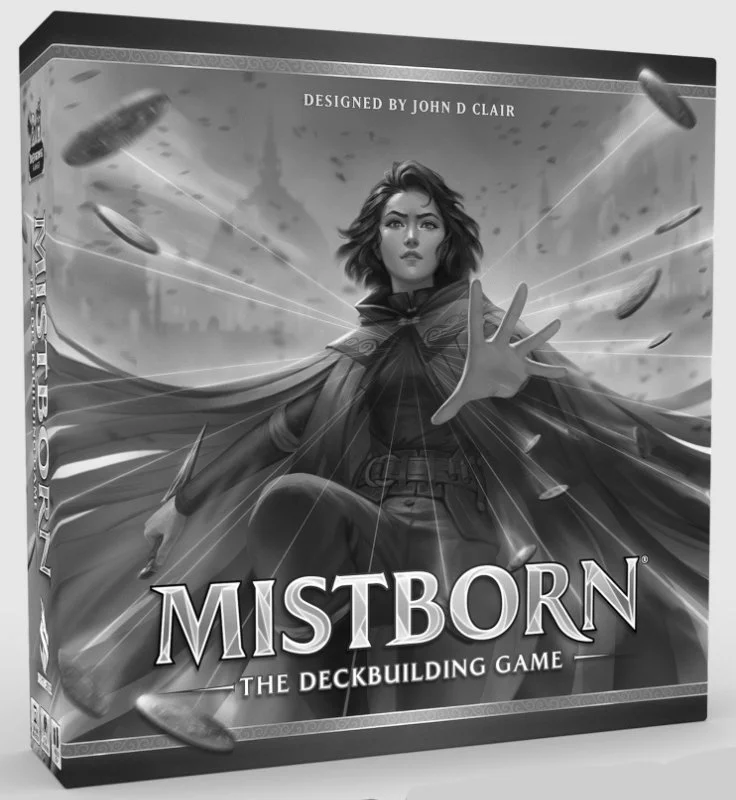
Mistborn: The Deckbuilding Game Cover
Mistborn: The Deckbuilding Game, is a competitive deckbuilder set in the world of Scadrial, inspired by Brandon Sanderson’s Mistborn novels.
In the game, you take on the role of a Mistborn—someone who literally ingests and burns metals to access superpowers. You’re battling other Mistborn in Luthadel, the city of ash and mist, all under the shadow of the Lord Ruler and his steel inquisitors.
What’s interesting is that even without having read the novels myself, the theme still pulled me in immediately. The world feels rich, strange, and cohesive, and the mechanics do a really good job of making you feel like a Mistborn.
What Makes Mistborn Feel Different
At its core, this is a deckbuilding game. You’re buying cards from a shared market, adding them to your deck, and watching your strategy slowly take shape as those cards cycle back into your hand.
But what really makes Mistborn stand out is the metal system.
There are eight different metals in the game, and each one supports a different style of play. Some help you deal damage, some help you move up the mission tracks, some generate coins, and others help you heal or defend. Over the course of the game, you naturally start gravitating toward a couple of metals that fit what you’re trying to do.
The clever part is that metals aren’t just resources. They’re also how you activate your cards. You physically take a metal token from your player board and place it on a card to power its effect. It’s tactile, intuitive, and it does a great job of reinforcing the theme.
Burning Metals, Using Cards as Fuel
Most turns feel like this you look at your hand of cards, then you decide which metal you want to burn to activate card powers.
Take a card like Steel Push. When you burn steel, you can either move up the training track or deal three damage. Later on the card, there’s another steel effect that gives you even more value. The catch is that you only have one steel token. Once it’s been used, it’s gone for the turn.
That’s where another great idea comes in. Many cards can be used as metals themselves. If a card has the right vial icon, you can turn it sideways to activate another card. This is why focusing your deck around a small number of metals is so powerful. Your cards stop being just actions and start becoming fuel for your engine.
Flaring Metals and Big, Risky Turns
Then there’s flaring.
Every metal token can be flipped over to show that it’s flared, which lets you burn more metals than you’re normally allowed to. Early in the game, you can only burn one metal per turn, so flaring is often the only way to have a big, exciting turn where everything goes off at once.
The downside is that flared metals don’t come back easily. Later, you’ll have to discard a card with a vial that matches the metal to refresh them. If you flare too much, you can end up spending turns fixing your board instead of advancing your strategy.
I’ve found that flaring is best used early, and ideally on metals you aren’t heavily relying on. If a metal isn’t central to your deck, flaring it can give you a strong boost without causing problems later.
How Games Actually End
Mistborn gives you a few different ways to win. You can race up all three mission tracks, you can eliminate the other players through damage, or you can pull off a very specific Atium-based win condition by spending four Atium on the card Confrontation.
In practice, almost every game I’ve played ends with either missions or damage. I’ve never actually seen the Confrontation victory happen. It feels more like a safety valve to keep the game from dragging on too long rather than something you should build your entire strategy around.
What a Turn Feels Like
If you’ve played deckbuilders before, the overall structure will feel familiar. Each turn starts with your character advancing on the training track, which slowly unlocks stronger abilities and allows you to burn more metals as the game goes on. That alone does a lot to keep the tension rising.
From there, you’re playing cards, burning and flaring metals, activating character abilities and allies, moving up mission tracks, and buying new cards or boxings from the market. At the end of the turn, any damage you generated gets resolved, everything gets discarded, and you draw a fresh hand.
It’s smooth, flexible, and once you’ve played a round or two, it flows very naturally.
A Few Gentle Strategy Tips for New Players
If you’re new to Mistborn, the biggest thing to understand is that this game rewards focus. It’s very tempting to buy lots of different cards because everything looks useful, but that usually leads to unfocused decks that struggle to do anything especially well.
One thing that surprised me early on was how strong boxings are. They’re simple, they don’t look exciting, but they make it much easier to afford the most powerful cards in the game. If you see a card in the market that costs six go for it. If you manage to grab one of those expensive cards early, you can often shape your entire strategy around it.
Another important decision is whether you’re trying to win through damage or by climbing the mission tracks. You don’t have to decide immediately, but once your direction becomes clear, it’s usually best to commit fully. Trying to do both at once rarely works out.
And then there’s Atium. Atium cards look incredible, and new players are often drawn to them, but most of the time the game ends before they really pay off. I’ve found they’re best used when a character ability lets you resolve a card immediately after buying it and then eliminate it.
The Characters and How They Feel to Play
Each character in Mistborn pushes you gently toward a particular style of play.
Marsh feels like the clearest path to a mission-based victory. Being able to move up mission tracks just by burning bronze is incredibly powerful, especially for newer players.
Kelsier leans hard into damage. Every time you burn steel, you’re hurting someone. If you enjoy aggressive play and forcing the table to react to you, he’s a great choice, even if the targeting system can sometimes feel a bit chaotic.
Vin feels balanced and resilient. Burning pewter gives you a little bit of everything, which makes her forgiving and flexible, even if she doesn’t always feel as explosive as the others.
Shan is the trickiest. Generating extra coins sounds great, but it can be easy to fall into the trap of buying expensive cards without a clear plan. That said, with the right focus—especially on mission tracks—she can absolutely win. Watching someone finally crack Shan is always satisfying.
Damage or Missions? It Depends
One of the biggest questions in Mistborn is whether you should focus on dealing damage or racing up the mission tracks.
Damage can be fast and disruptive. It forces other players into defensive decisions and can knock someone out of the game entirely. On the other hand, the targeting system means you don’t always control who you’re attacking, which adds a layer of unpredictability.
Mission tracks are quieter but relentless. A player can be inching forward turn after turn, and if no one intervenes, the game can end suddenly. The missions also give you powerful bonuses along the way, which makes that progress feel meaningful even before you win.
In the end, the best answer is usually dictated by the early market. The cards that show up in the first few turns often tell you what kind of game you’re about to play. Learning which cards are truly valuable is something that only comes with experience, and that discovery process is one of the most enjoyable parts of the game.
Allies and Long-Term Value
Allies are another interesting layer. Once they’re in play, they stick around, quietly generating value turn after turn. They also soak up damage, which can keep you alive longer and frustrate opponents.
If left alone, allies can snowball into something very powerful, especially when combined with zinc effects that trigger their abilities. It’s not always the right strategy, but when it works, it really works.
Who Is This Game For?
Mistborn: The Deckbuilding Game is a great fit for anyone who already enjoys deckbuilders and wants something with a bit more thematic weight. Fans of the novels will obviously get even more out of it, but you don’t need that background to enjoy the game.
It also includes a surprisingly robust solo and co-op mode where you take on the Lord Ruler, which makes it even easier to recommend if you enjoy playing on your own.
If there’s one thing I’m ready for, it’s an expansion. More cards, more characters, and new strategic wrinkles would be very welcome. Until then, there’s plenty here to explore—and a lot of satisfaction in learning when to burn, when to flare, and when to hold back.
Mindful Prompts
Most cell phones contain some copper, aluminum, and gold along with rare earth elements. When was the last time you thought about how physical metal has impacted your life?
How do you respond when the cards you want don’t appear in the market? Do you adapt easily, or do you feel frustrated or stuck?